The Weight We Carry
Some things were never meant to be carried alone.

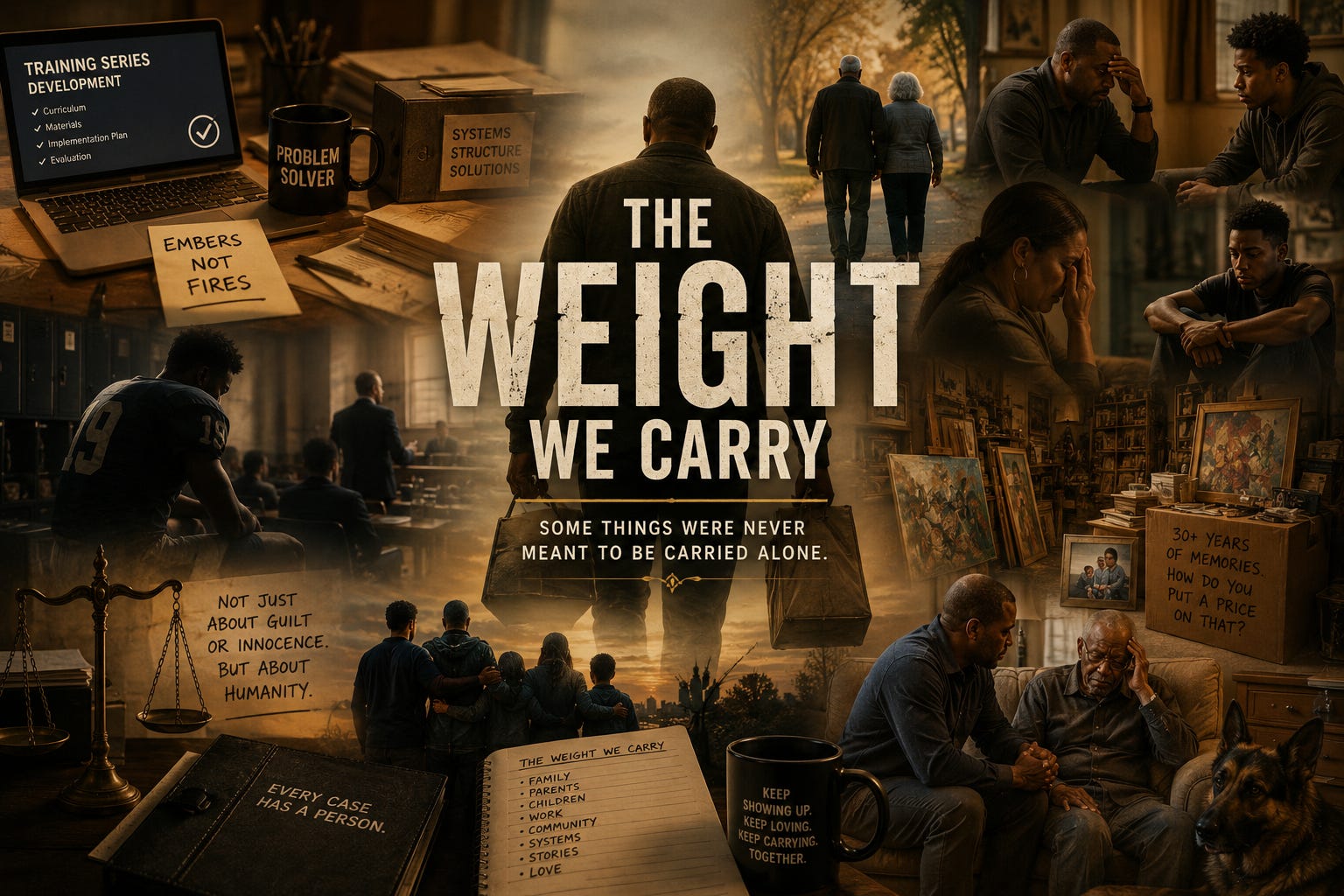
This week, I found myself thinking a lot about weight. Not the kind you measure on a scale. The kind you carry. The kind that settles into your chest. The kind that quietly follows you from room to room. The kind that doesn’t announce itself until you finally sit still long enough to notice how tired you are.
At first, I thought the weight belonged to work. My supervisor spent much of the week focused on responsibilities that required his attention elsewhere, which meant I needed to step forward and carry more of the day-to-day responsibilities than usual. Nothing dramatic happened. No crisis. No catastrophe. Just the steady reality of leadership. The emails still needed responses. The systems still needed development. The training materials still needed to be built. The families still needed support. The work still needed to move forward.
And it did. In fact, by week’s end I felt proud of what had been accomplished. Not because anyone handed me a trophy. Not because I received extraordinary praise. But because I realized something quietly important. I am no longer preparing to do the work. I am doing the work. That realization carries its own weight. Not a burden. A responsibility. The kind that asks you to keep growing into the person you’ve been trying to become.
But work wasn’t the only thing occupying my thoughts. Parenting found its way into the week as well. Parenting adult children is a strange experience. When they’re young, the responsibilities are obvious. You feed them. Protect them. Guide them. Help them tie their shoes. Teach them how to navigate the world. At some point, though, the responsibilities change. The problems become larger. The stakes become higher. The solutions become less clear.
And perhaps the hardest lesson of all is recognizing that love does not always grant you the power to fix what hurts the people you care about. Sometimes all you can do is remain available. Remain present. Remain loving. Even when the outcome is uncertain. Even when your advice is ignored. Even when your heart feels tired. This week reminded me that some of the deepest forms of love are not measured by how much we solve. They’re measured by how long we remain willing to stand nearby.
Then came a trip home. And if I’m being honest, that is where this article truly began. My parents are eighty and eighty-three years old. For most of my life, they have felt indestructible. Not perfect. Not superhuman. But steady. Reliable. The people who always seemed capable of carrying whatever life placed before them.
This week I sat with my mother as we talked about realities neither of us particularly enjoys discussing. The house. The storage. The art studio. The possessions accumulated over decades. The practical realities of aging. The conversations that eventually arrive whether we invite them or not. At one point, I found myself thinking about how strange it is that entire lifetimes can be stored inside buildings. Boxes. Furniture. Photographs. Artwork. Memories. Evidence that a life was lived fully and passionately.
How do you decide what stays? How do you decide what goes? How do you place a value on things that matter for reasons no appraisal could ever calculate? And perhaps most importantly... How do you watch people you love begin carrying burdens their bodies no longer want to carry?
I saw my mother cry. I shared some tears of my own. And somewhere inside that conversation, we stopped trying to solve everything. Instead, we began discussing something far more important. A plan. Not a solution. A plan. A way to distribute the weight. A way to carry it together. And that distinction has stayed with me all week. Because maybe maturity isn’t learning how to carry more. Maybe maturity is learning that some things were never meant to be carried alone.
That thought followed me into another experience this week as I prepared for an upcoming mock trial. My role is to portray a young Black man whose future hangs in the balance while others attempt to determine what happened and what justice requires. As I studied the case materials, I found myself thinking about another story unfolding in the national conversation. Different circumstances. Different facts. Different people. Yet something felt painfully familiar. Not because I knew the answers. But because I recognized the pattern. A young life becomes a headline. A complex story becomes a symbol. People rush toward certainty. And humanity quietly slips into the background.
What haunted me wasn’t guilt or innocence. What haunted me was familiarity. The feeling that our society continues carrying unresolved burdens from one generation to the next. The feeling that we become remarkably skilled at debating outcomes while avoiding the deeper work of examining causes. The feeling that so many people are carrying pain they did not create but somehow inherited.
Weight. Again. Everywhere I looked this week, there it was. At work. In family. In aging. In parenting. In community. In systems. In grief. In love. The weight we carry.
But perhaps the lesson isn’t about the weight itself. Perhaps the lesson is about what happens when we stop pretending we can carry everything alone. Because the strongest people I know aren’t the ones who never struggle. They’re the ones who understand when to ask for help. When to share responsibility. When to lean on others. When to create systems. When to build community. When to sit beside someone and simply help them hold what feels too heavy.
This week reminded me that life is less about proving how much we can carry and more about learning how to carry it together. And maybe that is where hope lives. Not in the absence of burdens. Not in the elimination of hardship. But in the realization that none of us were ever meant to walk through it alone. The weight is still there. But somehow it feels lighter when someone reaches out a hand and says, “I’ve got a corner of it.”
And sometimes, that’s enough.
The blessings of having both parents at my age and having adult children also come with changing roles and responsibilities. Our generation is the sandwich generation, we are sandwiched between the two and that brings its own set of responsibilities. The key is to be able to rely on siblings (if you’re blessed with them) and those closest to you. We have to remain aware of our own needs to keep helping others. So many layers, like the layers of a delicious and life giving sandwich…